






A
brief history of the Venkateswara Temple complex
at
Avadhoota Datta Peetham, Mysore
Introduction
1988:
Manginapodi, A tiny beachside hamlet near Masulipatnam. His Holiness
was bathing in the sea along with a large group of devotees. Suddenly
a black object was lifted by His Holiness. It was a two feet high black
granite statue of Lord Venkateswara. Sri Swamiji then exclaimed ! Lord
venkateswara is entereing Datta Peetham. In Manginapodi, Datta Peetham
has a branch, wherein is built an ancient Shiva temple and a Datta temple
recently consecrated by His Holiness. The Manginapodi is popularly known
as Datta Rameswaram"due to the consecration of 9 wells to
bath, as in Rameswaram.
In 1995:
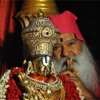
His Holiness announced that a Temple dedicated to Lord Venkateswara
would be built in the Mysore Datta Peetham premises. His Holiness further
announced that the facility , when completed, should serve as an institute
for training priests in the formal and proper way of offering services
to the deity. Various rituals that have to be performed from dawn to
dusk in a temple. "This is urgently needed in our country"
declared His Holiness. As the temple building involved several departments
of skilled artisans, a committee called "Sri Venkateswara Agama
Shikshana Kendra" was constituted . This commiittee is in overall
incharge of the development of the temple complex. Devotees took this
announcement as a Blessing. His Holiness envisaged a temple complex
consisting of the Maha Sannidhanam of Lord Venkateswara along with separate
shrines fo Goddess Padmavathy Devi, Ganapati, Dhanvanthari (the God
of Ayurveda, God of health), Navagraha ( full sized Navagraha idols
with each planet god having separate Pradakshina Marga), These temples
would be accessable from a huge Sabha Mantapa. The complex would also
contain Yaga Shala, Asthana Mantapa (to conduct temple ceremonies),
kitchen to prepare prasadam, quarters for the priest, cook and manager.
With this master plan in hand, we approached Vidwan Sri. Ananta Padmanabha
Acharya, an octegenerian pundit, reknowned for his mastery in Vaikhanasa
Agama ( the Agama scripture, that deals in the science of building,
maintaining and services for a Vishnu or Vishnu related temple). An
ardent devotee of His Holiness for over a decade, he readily accepted
and prepared the dimension, selected the appropriate site for the temple
complex in Mysore Peetham.
As instructed by His Holiness, two sets of Venkateswara and Padmavathy
idols were ordered. One set has been sculpted and supplied by Allagadda
Sthapathy of Andhra Pradesh . The sthapathy has won Presidents
award for art. The second set has been sculpted by Kanakarathinam Sthapathy
of Thiru Murugan Poondi. His Holiness decided that a Ganapati idol presented
by a devotee from Orissa state in 1993, be used for the Ganapati temple.
A well known Ayurvedic doctor from Mysore had gifted to the Peetham,
a Dhanvantari idol a few years ago. That will be used for the Dhanvanthari
temple.
Sri. Muttu Kannan, a venerated stone sculptor from Shiva Ganga region
in Tamil Nadu state was appointed as the chief stone sculptor. He visited
several stone quarries in Karnataka state to check the quality and the
sculpt worthiness of the stone. He selected a quarry in Avala Halli,
a tiny village near Kanakapura.
As the stone supply commenced, Sri. Muttu Kannan brought a band of stone
sculptors from his native village, Shiva Ganga. Numbering about forty,
they have constructed their working shed, their own smeltry to prepare
the chisels, hammers, etc. (Mind that a sharp chisel lasts only sixty
sconds of sculpting).
The plans of architectural features of the temple , as designed by Sri.
Padmanabhacharya, were effected in brick and mortar by renowned Sthapathy,
Sri. John Babu of Andhra Pradesh. His task also involved the construction
of Gopurams of the temples and the Raja Gopuram towering sixty feet
in the air.
The Dhwaja Sthambham, needed a teak wood tree, measuring not less then
sixty feet in length and not less than 100 cms in circumference at the
base. A tree was located in a remote forest in Kerala and was shifted
to the temple premises. A band of carpenters seasoned the tree and shaped
it in to a Dhwaja Sthambham.
All the constructions have been professionally designed and executed
by a reputed civil construction company under the watchful supervision
of devotee engineers.
The temple is slated to be ready for Prana Pratishthapanam and Kumbhabhishekan
23rd June, 1999.
Introduction