
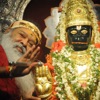
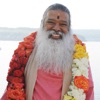

Parama Poojya Sri Swamiji arrived for the Navaratri Pujas at 9:00 a.m. after giving Purnahuti for the Ganapati Homam at 7:30 a.m.. After Kumari puja Sri Swamiji started the Avarana pujas
The morning music concert was a Carnatic (South Indian style of music) vocal duet by Rudrapatnam brothers, Sri. R.N. Thyagarajan and Sri. R.N. Taranath. They were accompanied by Sri. M.A. Suandareshan on the violin, Sri. A.V. Anand on the Mridangam and Sri. S.V. Raman on the Ghatam. Rudrapatnam brothers sang Sri Swamiji's composition "Guru Charanam Namata Muda", Kakada Arati bhajan of thursday. It was beautifuly rendered and was appriciated by everyone.
Anna Archana to Meenakshi was performed with Puliyogare, a traditional rice dish of South India. This prasadam was given to the devotees after the Purnahuti of Devi homa.
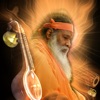
The afternoon music concert was a Veena (stringed instrument) concert by Smt. Anuradha Madhusudhan. She was accompanied by B.C. Cheluva Raju on the Mridangam and Sri. K.N. Krishna Murthy on the Ghatam.
Sri Swamiji in the Bhajan session sang Jai Jai Ganapati. Then He sang a new Bjhajan "Hari Hara Vidita" . Later Sri Swamiji sang "Meenakshi Prantosmi", a very beautiful old bhajan on Godess Meenakshi.
Sri Swamiji explained in His discourse the story of Nageswarai Devi who was born with the aspect of ParaSakti (The Supreme Energy- The Universal Mother). The narration was given by Sri Swamiji during the spiritual discourse after Mahamangala Harati.
Kashyapa Prajapati created Adisesha from the life energy and Nageswari, his sister with an aspect of Universal Mother.Nageswari Devi was a sinere disciple of Siva and after study of all branches of knowledge, she became an ardent devotee of vishnu and performed severe penance for 3 lakh years.
During the course of time, King Janamejaya performed a Serpent Yaga at the beginning of Kali Yuga. This Yaga caused havoc not only to the species of serpents but also to the various celestials with an aspect of serpent. The reason is that most of the celestials have an aspect of serpent as with those prolonged practice of Pranayama (breathing exercise) only they could reach the celestial world.We think of those serpents seen in the forest or in anthillls when we hear the word serpent. However as per the scriptural connotation, these are mere petty creature. The real aspect of serpent is acquired only by those who live beyond 12 years.However, some of the celestials who attain that status after severe practice of Pranayama acquire the aspect of Garuda, the vehicle of Vishnu, Garuda or Guru mantra also has a predominant aspect of Vayu(air) such type of celestials with the aspect of Garuda have a great capacity to move about freely in the skies (Gagana Sanchara) . Anyway about 80% of the celestials have the aspect of serpent(NAGA AMSA).Among the very important deities, Vishnu rests on a Naga, serpent(Naga Talpa Sayi), Siva's ornaments are Nagas(serpents). These points signify the Naga Amsa(aspect of serpent) among celestials. Even among the human beings several have Naga Amsa. However among them, it is of three types viz., Deva Naga, Manushya Naga and Rakshasa Naga.
People with Deva Naga Amsa i.e.., with aspect of serpent having a small aspect of divinity, observe moderation in all activities. They do not over eat. They do not sleep too much. They do not hanker of pleasures. Their spiritual practice proceeds properly and well. People with Manushya Naga Amsa i.e.., with the aspect of serpent having a human aspect, have the predominant feature of Rajas (Rajo Guna) . Hence their spiritual practice has frequent ups and downs. However they try to crawl to higher level. If such people put in a good effort, they can reach the first status, i.e.., Deva Naga Amsa.
People with Rakshasa Naga Amsa i.e.., with the aspect of serpent having a demonic tinge - are always engrossed in the worldly worries and ever engaged in monetary affairs. Even when they visit a temple, monastery or any place of worship, they continue to engage themselves in worldly thoughts and words only. Such people must make a very strenuous effort to progress. Let us now revert to the story, we recollect that all the celestials were very much upset, due to the Sarpa Yaga. After seriously thinking over the problems among themselves, they encouraged Adisheshsa and Pitrudevatas-celestials, who became so after death on the earth to take necessary steps to stop the Sarpa Yaga. During that period, there was one sage by name Jaratkara engaged in penance for thousands of years. By nature he was very angry . Pitrudevatas went to him and said "Unless you marry, we - your ancestors will be doomed to hell". Thus they expressed their grief. Jaratkara had no other go. Hence he said "If a maiden bearing my name offers herself to marry me(without my effort to seek), I will marry". Then Adishesha persuaded his sister Nageswari who was in deep penance and transformed her as a human maiden bearing the name Jaratkaru.Adishesha assumed the form of a Brahmana along with his sister and settled in a village just close to the hermitage of Sage Jaratkara.
It was the practice of Jaratkara to go for Bhiksha only once in a year! He used to take whatever is offered to him.
This time just on Jaratkara's arrival at his house, Adishesha said "I am offering my sister as Bhiksha to you. She is very much accustomed to perform penance. Her name is Jaratkaru". Something, quite unexpected really happened! Hence it was inevitable to Jaratkara to marry. He said "I will not look her. I will not speak to her. If she violates these conditions, I will leave her. In case you are agreeable, your perform the marriage". Adishesha readily agreed. Jaratkaru Devi, the repository of knowledge- sincerely served her husband for many a year without causing any anger to him. Once the sage was asleep in the evening, shortly the sunset will occur. A ritualistic person should perform SANDHYA VANDANA just at sunrise and sunset. The lady was in a dilemma. If she woke him up, he would get angry , she did not wake him up, he would get angry, (as anyone sleeping at sunset time acquires sin). She analyzed thus "whether I wake him up or not- either way he will get angry. However if I do not wake him up, I will be failing in my duty becoming the cause for his non performance of timely rituals(which is sinful). Also the deities will curse him. Let me choose the other option and wake him up, so that he only may get angry". Deciding thus, she woke him up. As expected, the sage became wild with rage He shouted angrily "Can the Sun dares to set while I am asleep? Don't you know that much? My power of penance is so much ! Do you insult me thus? I am leaving you". However, the lady prostrated to him and said softly "Sir, How about your promise to Pitrudevatas-(celestials who were your ancestors)?" Listening to these words, the great sage looked at her seriously and uttered the single word "ASTI"(EXISTS) and left the place permanently.
The very seriousness of his LOOK made her pregnant on the spot. She named after the boy child born to her as "ASTIKA" (connected to the sage's word ASTI). Thus the intention of Adishesha and Pitrudevatas bore fruit. Astika, the Sage's son was blessed by all deities just at the time of birth and became a great sage excelling his pious parents even. Meanwhile king Janamejaya commenced Sarpa Yaga. Even great sages like Vyasa even could not stop it. Suddenly Astika came to the Sarpa Yaga. Astonished by the young Astika's brilliance, the king Janamejaya offered him to ask for a boon. Astika asked for the stoppage of Sarpa Yaga. It was stopped. Nageswari Devi who thus achieved the divine purpose took the form of MANASA DEVI- the repository of the power of all Mantras- both at Manasa Sarovar as also at Haridwar. The temples still exists and are visited by countless devotees even today. Manasa Devi bestows the grace of Universal Mother to her devotees. Whichever Mantra one recites, the very invocation of Manasa Devi enables the person to attain quicker achievement(Siddhi) of the mantra. May your desires be fulfilled with the grace of Manasa Devi.
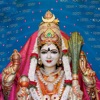
Today Sri Swamiji worshipped Meenakshi Devi as the principal deity during NAVA RATRI Festival. After puja, he rendered Meenakshi Pancharatna stotra of Adi Shankara.